
Community theater taught my shy teenager something school never could
Community theater gives shy teenagers a low-stakes place to practice speaking, teamwork, and self-expression—skills that may be harder to develop in a conventional classroom. For my teenager, joining a local production did not erase shyness or turn them into someone else; it gave them a reason to speak up, a group to rely on, and repeated chances to take small social risks. Research supports the value of arts participation for young people, though it does not prove that theater alone causes every benefit. The experience is best understood through its effects on confidence, belonging, and practical social skills, as well as the limits families and theater groups should keep in mind.
Community theater builds confidence through practice
Community theater is locally organized performance made with volunteers or amateur performers, often involving people of different ages and experience levels. For a teenager, it can include acting, backstage work, stage management, costumes, lighting, or set construction. The National Endowment for the Arts describes arts participation as a way people engage with artistic activities, while its research on arts education has examined associations between arts learning and outcomes such as academic achievement and civic engagement. These findings are encouraging, but they should not be read as proof that a play will automatically make a shy student confident.
The difference from school may be the structure of the challenge. In class, a student might be asked to speak without choosing the topic or role. In a production, a line, cue, or backstage task gives speaking a clear purpose. Rehearsal also makes progress visible: a teen can learn one scene, repeat it, receive direction, and gradually perform it for others. That progression can turn a frightening social task into a manageable series of steps.
Confidence grows through repeated, supported exposure
Confidence is not the same as becoming extroverted. It is the belief that one can attempt a task, handle mistakes, and try again. A theater rehearsal offers repeated exposure to speaking, being observed, and responding to feedback. The American Psychological Association explains that gradual exposure is commonly used in cognitive behavioral approaches to help people face feared situations; however, a youth theater program is not therapy, and it should not be presented as treatment for anxiety.
For my teenager, the first useful step was not a starring role. It was showing up, reading a few lines, and learning where to stand. Small successes accumulated: speaking loudly enough to be heard, asking a castmate a question, and eventually performing in front of an audience. The meaningful measure was not whether shyness disappeared, but whether the teenager felt more able to participate despite it.
Belonging gives teenagers a shared purpose
Belonging means feeling accepted and valued within a group. A cast can create that feeling because each person’s contribution supports a common production. Teenagers who do not seek attention may find connection through a quiet role backstage, a shared joke during rehearsal, or the routine of working toward opening night.
The U.S. Surgeon General’s 2023 advisory on social connection identifies meaningful relationships and community participation as important to health and well-being. Theater is one possible setting for connection, not a guaranteed remedy for loneliness. The quality of the adult leadership matters: a welcoming director can make room for different personalities, while a competitive or dismissive environment can make participation more stressful.
Community theater teaches transferable social and practical skills
A transferable skill is an ability that can be used in settings beyond the activity where it was learned. Theater combines communication with coordination: performers listen for cues, crews meet deadlines, and everyone adjusts when a scene or technical element changes. The National Core Arts Standards describe creating, performing, responding, and connecting as central processes in arts learning. Community productions may not follow a school curriculum, but their work naturally involves many of these processes.
These skills often develop through practical tasks rather than lectures. A teenager learns to listen because missing a cue affects another actor. They learn to accept feedback because a scene improves through revision. They learn responsibility because a prop, costume, or lighting change must be ready at the right moment. This gives theater a distinctive kind of learning: social skills are practiced in service of a shared, concrete goal.
Listening, collaboration, and communication
Collaboration is coordinated work toward a shared outcome. Onstage, it means responding to scene partners rather than simply reciting lines; backstage, it may mean coordinating a quick costume change or setting. A shy teen can contribute without needing to dominate a conversation. Over time, the structure offers practice in asking for help, offering ideas, and speaking clearly when the group needs it.
The National Endowment for the Arts’ research on arts education has reported associations between sustained arts participation and positive educational outcomes, including stronger academic performance in some analyses. Those results are correlational and can reflect other influences, such as family resources or school support. For a family considering theater, the more immediate evidence may be observable: Is the teenager communicating more comfortably with peers? Are they following through on commitments? Do they feel included?
Reliability, problem-solving, and learning from mistakes
A production depends on reliability: people arrive, remember responsibilities, and adapt when something goes wrong. A missed line or misplaced prop can become a prompt to recover rather than a reason to quit. That experience helps teenagers see mistakes as part of a process, especially when directors correct errors respectfully and model calm problem-solving.
The U.S. Department of Education’s National Center for Education Statistics has documented that students participate in a range of extracurricular activities, though participation and access differ across communities and student groups. Theater should therefore be viewed as one useful option among many, not a universal solution. Transportation, fees, disability access, rehearsal hours, and family schedules can determine whether a young person can take part.
Community theater offers more than acting roles
A common misconception is that theater benefits only teenagers who want to perform. In reality, a production is a network of artistic and technical roles. Offering several entry points matters for shy students: they can become part of the group before deciding whether they want to be seen onstage. A theater’s culture should treat backstage work as essential rather than as a lesser alternative.
Backstage work can be a first step into the group
Backstage participation includes lighting, sound, set building, props, costumes, publicity, and stage management. These roles build technical knowledge and shared responsibility while allowing a teenager to contribute with less public performance pressure. A student who begins by organizing props may later feel ready to read for a part—or may discover that technical theater is the right fit.
This flexibility is especially valuable when a teenager is curious but apprehensive. Families can ask whether a production accepts beginners, provides supervision for younger crew members, and allows participants to try different roles. Clear expectations and a patient orientation can make the first rehearsal less intimidating.
A production creates a real-world learning cycle
Theater follows a visible cycle: prepare, rehearse, receive feedback, revise, and present. The audience’s response makes the result feel meaningful, while the rehearsal process shows that performance depends on practice rather than instant talent. The National Core Arts Standards’ emphasis on creating, performing, responding, and connecting reflects this cycle, linking individual expression with interpretation and community experience.
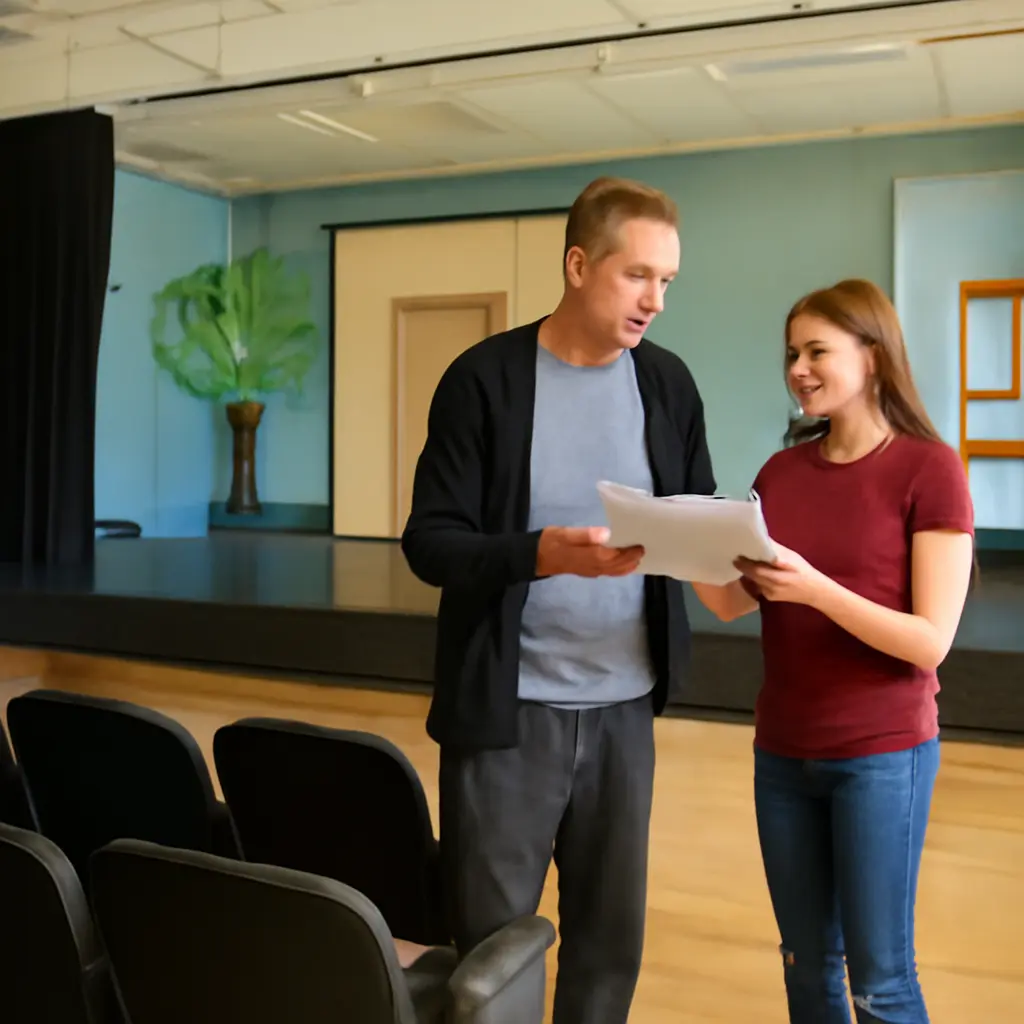
A useful example is the teen who initially avoids speaking in a group but volunteers to read one character’s lines during auditions. After being cast—or joining the crew—they attend regular rehearsals, learn the production’s routines, and eventually take part in a public performance. That sequence is not a guaranteed outcome for every participant; it illustrates how a structured activity can offer gradual challenges and tangible milestones.
Choosing a supportive theater experience
The benefits depend on the environment. A good program welcomes beginners, sets age-appropriate expectations, and responds constructively to mistakes. Before signing up, families can attend a performance, speak with the director, and ask how auditions work, what participation costs, how late rehearsals run, and whether students can choose backstage roles. It is also reasonable to ask about supervision, inclusive practices, and how the group handles conflict.
Pay attention to the teenager’s own reasons for joining. A shy student may want to act, help with costumes, make friends, or simply try something new. Encourage a first step without turning the experience into a test of courage. If rehearsals become persistently distressing, the family can discuss adjustments or another activity; theater should offer challenge and support, not pressure to perform socially on demand.
Conclusion: community theater makes room for quiet growth
Community theater can help shy teenagers practice confidence, belonging, collaboration, communication, and problem-solving through a shared creative project. Its value is not limited to acting: backstage roles offer meaningful ways to participate, and the rehearsal cycle gives young people repeated chances to prepare, receive feedback, and try again. Research from arts and health organizations supports the importance of arts participation and social connection, while reminding us that outcomes vary and access is not equal.
For my teenager, theater offered something school had not: a role within a group where speaking had a purpose and contribution mattered. Families can explore local productions, ask about beginner-friendly and backstage opportunities, and let the young person decide what kind of participation feels right. Sometimes the first step toward confidence is not standing center stage; it is finding a place in the company.
Sources: National Endowment for the Arts, Arts Education Research, https://www.arts.gov/impact/research/arts-data-profile-series/arts-education; National Core Arts Standards, National Core Arts Standards, https://www.nationalartsstandards.org/; U.S. Surgeon General, Our Epidemic of Loneliness and Isolation: The U.S. Surgeon General’s Advisory on the Healing Effects of Social Connection and Community, 2023, https://www.hhs.gov/sites/default/files/surgeon-general-social-connection-advisory.pdf; American Psychological Association, Exposure Therapy, https://www.apa.org/ptsd-guideline/patients-and-families/exposure-therapy; National Center for Education Statistics, The Condition of Education: Extracurricular Participation, https://nces.ed.gov/programs/coe/