
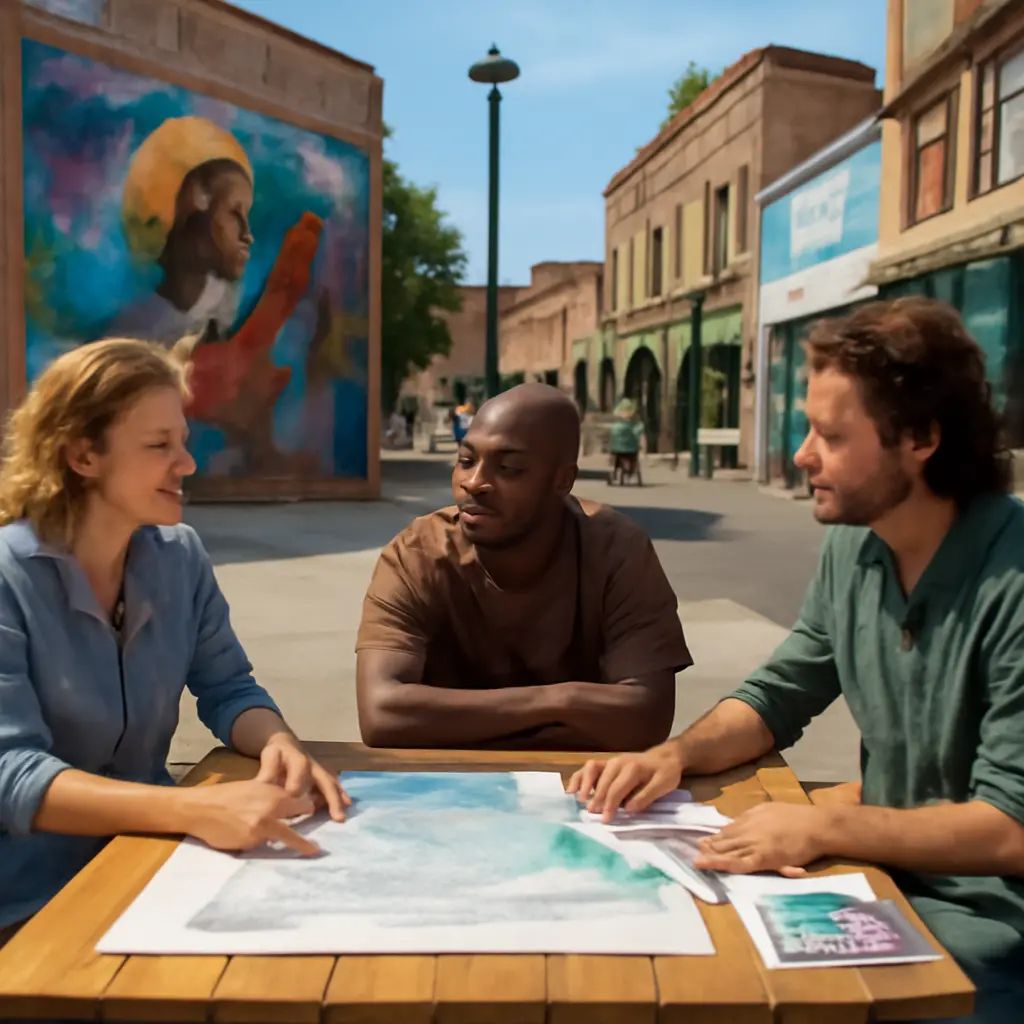
The shift from serving audiences to building artistic neighborhoods
Artistic neighborhoods are place-based networks where artists, cultural organizations, residents, businesses, and public institutions shape creative life together. The shift from serving audiences to building these neighborhoods means treating people not only as ticket buyers or visitors, but as participants, collaborators, and long-term stakeholders. Research on creative placemaking, community arts, and cultural districts points to why this matters: the National Endowment for the Arts has emphasized that arts participation can strengthen civic connection, while the U.S. Bureau of Economic Analysis has documented the arts and cultural sector as a significant contributor to the national economy. The change also raises practical questions about who benefits, who has decision-making power, and how cultural activity can endure without displacing the people who make a place distinctive.
Community participation defines the artistic-neighborhood model
An artistic neighborhood is more than a concentration of galleries or performance venues. It is a local ecosystem in which cultural activity is connected to everyday life, shared spaces, relationships, and neighborhood priorities. In its creative placemaking framework, the National Endowment for the Arts describes creative placemaking as a process in which partners from public, private, nonprofit, and community sectors shape the physical and social character of a place around arts and cultural activity. This definition helps distinguish a neighborhood-building approach from a program designed primarily to attract an audience to a single event or institution.
The distinction is consequential. An audience-centered institution often measures success through attendance, ticket revenue, or visitor satisfaction. A neighborhood-centered effort may also track local participation, artist retention, affordable workspaces, resident influence, and whether cultural investment supports existing communities. These approaches can overlap: audiences remain important, but they become part of a broader network rather than the sole measure of cultural value.
From audience development to shared cultural stewardship
Audience development is the work of reaching, welcoming, and retaining people who attend cultural offerings. Shared cultural stewardship extends that work by inviting residents and artists to help shape what is offered and how it is produced. The shift does not require institutions to abandon programming or professional standards. Instead, it asks them to build lasting relationships with the people whose lives and histories are connected to the place.
This broader view aligns with the National Endowment for the Arts’ Survey of Public Participation in the Arts, which measures cultural engagement beyond attendance at conventional venues, including arts participation through media, personal practice, and community settings. Such measures matter because a neighborhood’s creative life may be active even when residents are not buying tickets to a museum or concert hall. Community festivals, informal music-making, cultural traditions, and neighborhood workshops all contribute to local participation.
Creative placemaking connects culture to place
Creative placemaking uses arts and culture as part of broader place-based work, often involving partners in housing, planning, transportation, education, and economic development. It can include public art, cultural corridors, artist-led neighborhood planning, or the reuse of vacant buildings for cultural purposes. The strongest approaches connect creative activity to locally identified needs instead of treating art as a decorative layer added after major decisions have been made.
A useful contextual bridge is the difference between a cultural district and an artistic neighborhood. A cultural district is commonly a formally recognized area with a concentration of cultural organizations or activity. An artistic neighborhood is a wider social and civic idea: cultural participation, relationships, and local identity may extend beyond a mapped district or institution. Both can support one another, but neighborhood-building depends on whether residents and artists can influence the direction of cultural investment.
Local networks make artistic neighborhoods durable
The central attribute of an artistic neighborhood is not simply the number of creative businesses in a place; it is the quality of connections among them and with the wider community. The Urban Institute’s work on arts and culture in communities stresses the importance of understanding cultural assets in context, including informal and community-based activity that may not appear in conventional institutional counts. A neighborhood approach therefore maps relationships as well as venues: who collaborates, who has access, and who is missing from decision-making.
Artist networks and affordable creative space
Artist networks are the working relationships that connect individual creators to studios, rehearsal rooms, fabricators, mentors, audiences, and one another. Affordable space is a key part of this infrastructure because artists need places to make, teach, rehearse, exhibit, and store work. The National Endowment for the Arts’ research on arts employment and the creative economy shows that cultural work spans many occupations and types of organizations; it is not limited to salaried jobs inside major institutions.
When rents rise, a neighborhood can lose the people and small organizations that helped establish its cultural identity. The Urban Institute has examined how arts-related development can contribute to neighborhood change, underscoring the need to consider affordability and displacement alongside investment. Strategies such as long-term leases, nonprofit ownership, shared workspaces, and artist housing can help keep creative infrastructure accessible, although each requires local partnerships and sustained financing.
Resident-led programming and cultural belonging
Resident-led programming gives community members meaningful influence over cultural priorities, formats, and resources. This may involve paid advisory roles, co-produced events, neighborhood commissions, or participatory budgeting. It differs from consultation that occurs only after a project has been designed: residents help define the question, not merely comment on the proposed answer.
The approach is particularly relevant in neighborhoods with longstanding cultural traditions or communities that have been underrepresented by established institutions. The National Endowment for the Arts’ arts-participation research documents varied ways people engage with the arts, reinforcing that cultural belonging is not confined to formal venues. A neighborhood strategy can build on local practices—such as festivals, craft traditions, storytelling, and music—while creating new opportunities for exchange across generations and communities.
Cultural districts and local business ecosystems
Cultural districts group cultural organizations, creative businesses, and public activity within a recognizable area. They can make cultural assets easier to find and support visitor activity, but their value depends on how benefits circulate locally. Partnerships with independent retailers, restaurants, community organizations, and local workers can connect cultural programming to the neighborhood economy rather than directing spending only to large institutions or outside vendors.
The Bureau of Economic Analysis’ Arts and Cultural Production Satellite Account tracks the sector’s contribution to gross domestic product, employment, and compensation. Its accounting framework illustrates that arts and culture generate economic activity across industries, from performing arts and museums to design and related services. Those national figures do not establish that every cultural district benefits nearby residents; local evaluation is still needed to determine who receives contracts, jobs, customers, and investment.
Shared governance turns cultural activity into neighborhood capacity
Shared governance is the set of structures through which artists, residents, cultural organizations, and public partners make decisions together. It is a practical test of whether a neighborhood initiative is genuinely collaborative. The Kresge Foundation’s creative placemaking work, like that of the National Endowment for the Arts, has supported cross-sector approaches that bring cultural partners into community development. The essential question is not whether partners appear on a project roster, but whether their roles carry authority, resources, and accountability.
Co-design and decision-making power
Co-design is a process in which affected people help shape a project from its earliest stages. In an artistic neighborhood, it can mean artists and residents jointly setting program goals, choosing sites, establishing selection criteria, and reviewing outcomes. Effective co-design requires accessible meetings, compensation for community expertise, clear communication about constraints, and a record of how public input changes decisions.
This process can improve relevance and trust, but it is not automatically equitable. If participation is unpaid or conducted only in formats that exclude working families, disabled people, or residents who speak languages other than English, the process may reproduce existing imbalances. Institutions can strengthen participation by offering stipends, childcare or transportation support, interpretation, and multiple ways to contribute.
Cross-sector partnerships and civic infrastructure
Cross-sector partnerships connect arts organizations with groups responsible for housing, health, education, workforce development, and public space. These relationships can make cultural work more durable because they link creative projects to services and systems that shape daily life. For example, a community arts organization may collaborate with a school on youth programming, a housing group on resident engagement, or a planning department on the design of a public space.
The National Endowment for the Arts’ Our Town program has supported creative placemaking projects across the country through partnerships between arts organizations and local governments or community partners. The program’s structure reflects an important principle: culture can contribute to civic development, but successful work requires partners with complementary expertise. Arts organizations should not be expected to substitute for affordable housing, public services, or fair labor practices.
Evaluation beyond attendance
Evaluation beyond attendance measures whether cultural work builds relationships, access, local capacity, and lasting benefit. Useful indicators can include the share of participants who live nearby, compensation paid to local artists, repeat partnerships, availability of affordable creative space, resident influence over budgets, and perceptions of belonging. These indicators complement, rather than replace, attendance and financial measures.
A simple textual scorecard can group measures into four categories: participation, with counts of residents involved in planning and programming; access, with information on cost, location, language, and disability inclusion; economic circulation, with local hiring and purchasing; and continuity, with multi-year partnerships and retained affordable space. Combining quantitative indicators with interviews and community-defined measures gives a fuller account than a single attendance figure.
Equity safeguards protect the neighborhood being built
Equity safeguards are policies and practices intended to ensure that cultural investment does not exclude the communities it is meant to serve. They matter because new cultural visibility can attract property investment and visitors, while also increasing pressure on rents and local businesses. The Urban Institute’s research on arts, culture, and neighborhood change highlights the importance of examining these effects rather than assuming that cultural activity produces shared prosperity automatically.
Anti-displacement planning
Anti-displacement planning links cultural investment with measures that help residents and creative organizations remain in place. Options include preserving affordable housing, supporting community land trusts, protecting small businesses, offering long-term leases to cultural groups, and monitoring rent or business turnover. These measures require collaboration with housing and economic-development partners; an arts organization cannot address displacement through programming alone.
The practical lesson is to plan for affordability before a neighborhood becomes a destination. A project can establish baseline conditions, identify groups at risk of being priced out, and report changes over time. This makes it possible to distinguish increased cultural activity from equitable neighborhood improvement.
Representation, access, and fair compensation
Representation concerns whose stories, practices, and expertise are visible in cultural life. Access concerns who can participate, while fair compensation recognizes the labor involved in creating and sustaining that participation. Together, these principles shape whether a neighborhood’s cultural institutions reflect local communities or rely on their contributions without sharing authority or resources.
Institutions can put these principles into practice by paying community advisers and artists, publishing selection criteria, making programs accessible, and tracking who receives commissions and contracts. Data should be interpreted with care: demographic counts can show patterns, but they do not explain whether people feel respected, safe, or able to influence outcomes. Qualitative feedback and transparent follow-up are essential complements.
Conclusion: build with the neighborhood, not only for its visitors
The shift from serving audiences to building artistic neighborhoods reframes cultural success around participation, relationships, shared governance, and local staying power. Creative placemaking connects arts and culture to place; artist networks and affordable spaces support the people who make culture; resident-led programming strengthens belonging; and evaluation beyond attendance helps reveal who benefits. Cross-sector partnerships and anti-displacement safeguards are necessary to ensure that cultural investment contributes to a neighborhood’s future without eroding its existing strengths.
Arts organizations, funders, and local governments can begin by mapping cultural assets with residents, compensating community expertise, identifying affordability risks, and publishing measures of both participation and benefit. The broader implication is that culture is not simply a product delivered to an audience. It is also a shared civic resource—one that becomes more resilient when the people who live and work in a place help shape its creative life.
Sources: National Endowment for the Arts, Creative Placemaking, https://www.arts.gov/impact/creative-placemaking; National Endowment for the Arts, Survey of Public Participation in the Arts, https://www.arts.gov/impact/research/arts-data-profile-series/adp-31; National Endowment for the Arts, Our Town, https://www.arts.gov/grants/our-town; U.S. Bureau of Economic Analysis, Arts and Cultural Production Satellite Account, https://www.bea.gov/data/special-topics/arts-and-culture; Urban Institute, Arts and Culture in Communities, https://www.urban.org/policy-centers/center-nonprofits-and-philanthropy/projects/arts-and-culture; Urban Institute, Creative Placemaking and Neighborhood Change, https://www.urban.org/urban-wire/creative-placemaking-and-neighborhood-change; Kresge Foundation, Arts and Culture, https://kresge.org/our-work/arts-culture/